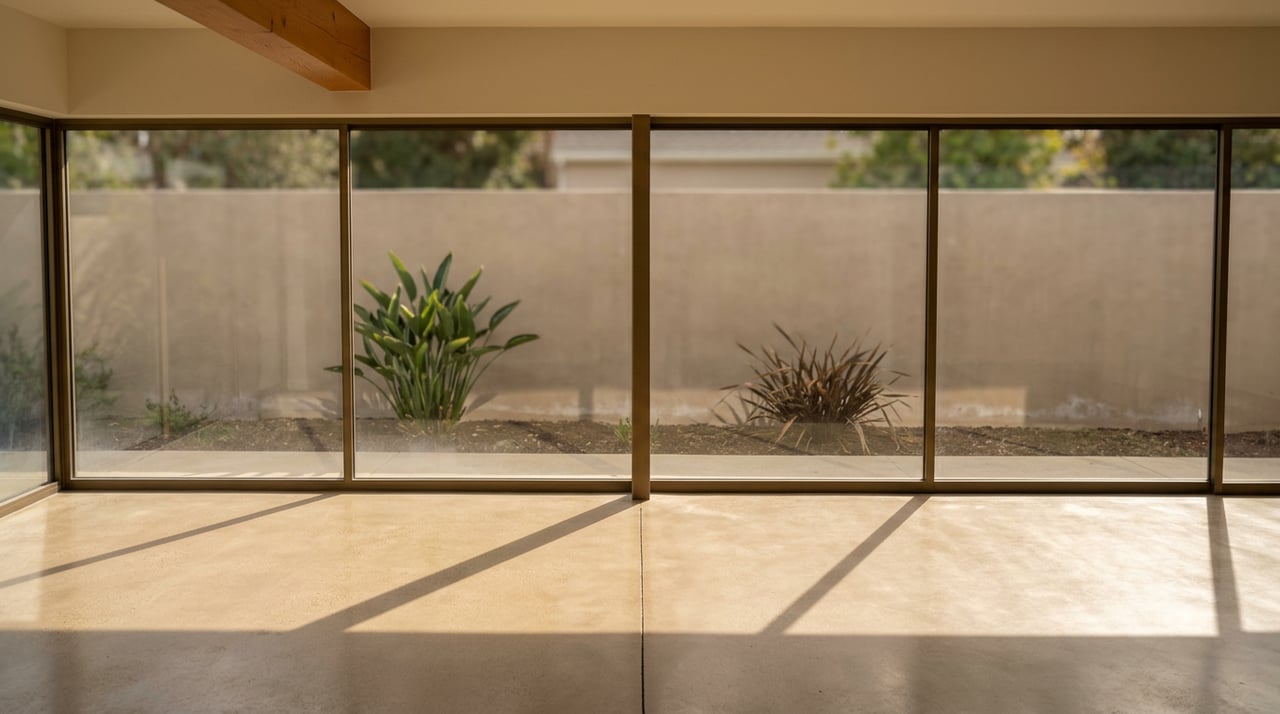
Walk a listing on Campbell Avenue or Fordham Avenue in Thousand Oaks and the atrium gets all the attention. Floor-to-ceiling glass, post-and-beam ceilings, a planted courtyard open to the sky in the middle of the house. It is easy to fall for the architecture and forget to ask about the one system that will actually decide your negotiation: what is running through the slab under your feet.
Thousand Oaks holds one of only two Eichler tracts in the Los Angeles and Ventura County area, a roughly 100-home development built between 1964 and 1966 on Campbell Avenue, Stoddard Avenue, Fordham Avenue, and Camino Manzanas near Lynn Road. The Acorn newspaper describes 103 mid-century modern homes tucked into a three-block pocket, distinguished by their colorful front doors and the atrium layout that made Joseph Eichler's developments famous nationally. It was his last tract. The homes were designed by the firm of Jones and Emmons and by Claude Oakland, both regular Eichler collaborators, and the atrium models here run four to five bedrooms across roughly 1,800 to 3,000 square feet.
None of that shows up in a typical home inspection report. What matters more, and what most buyers never think to ask about until they are already in escrow, is whether the radiant heating system embedded in the concrete slab is copper or steel.
What every Eichler in this tract shares
Eichler homes were built on slab foundations with hydronic radiant heat: a boiler circulates hot water through a closed loop of tubing buried in the concrete, warming the floor from below instead of pushing air through ducts. It is quiet, even, and part of why these homes still draw design-minded buyers sixty years later. It is also a system that a standard home inspection is not built to evaluate. A general inspector checks visible plumbing, fixtures, and drainage. Testing pressure on a slab loop that has been buried since 1964 is specialty work, closer to what a hydronic heating contractor does than what shows up on a typical inspection checklist.
That gap matters because the two materials used in these systems age in completely different ways.
| Copper piping | Steel piping | |
|---|---|---|
| Repairable when it leaks | Usually yes | Generally no |
| Why it fails | Stress where the tube crosses a slab crack, not internal corrosion | Internal corrosion and degradation over decades |
| Typical pattern | One to five leaks over 30 to 50 years is considered normal aging | Once one section starts leaking, more tend to follow |
| What a leak means for the homeowner | A localized repair, usually a small section of slab opened and patched | Often a decision to abandon the system in favor of baseboard, mini-splits, or a full replacement |
Contractors who specialize in this work describe copper systems as a closed loop with no electrolytic degradation, meaning the failure mode is almost always physical stress rather than the pipe simply wearing out from the inside. Anderson Radiant Heating also notes something specific to tract construction like this one: Eichler tract slabs were often poured thinner and less uniformly than a custom home's slab, which means more movement and cracking over the decades than you would see in a one-off architect-built house. That is a detail worth sitting with if you are comparing a tract Eichler to a custom mid-century home elsewhere in the Conejo Valley. The tract construction that made these homes affordable in 1964 is the same construction that makes the slab more prone to the kind of stress cracks that eventually reach a buried pipe.
Steel tells a different story, and the timeline matters here. Builders turned to galvanized steel during the copper shortages of the Korean War era in the early 1950s, then generally went back to copper once that shortage eased. Because this Thousand Oaks tract was not built until 1964 through 1966, the odds favor copper in most of these homes. Odds are not certainty, and no two houses on these streets were necessarily plumbed the same way by the same crew. Once steel does begin to corrode, it generally cannot be patched the way copper can, and a 2025 piece from a contractor who works on these systems regularly puts it plainly: steel usually means replacement, not repair, once failure starts. There is a quick way to check which material you are dealing with before you ever open a wall. Find the manifold, typically near the water heater or in a utility closet, and hold a magnet to the pipe. If it sticks, it is steel.
The cost conversation nobody has until it's too late
Recent pricing on copper pinhole repairs runs in the range of $1,850 to $2,500 per leak, based on 2025 figures from a contractor who works specifically on Eichler radiant systems. A single leak, if the rest of the loop tests sound, is a manageable fix. A pattern of leaks close together, or a system that has already been converted to a manual bleed-and-refill routine to keep it running, is a different conversation entirely.
Full system replacement is more involved. It typically means removing flooring, cutting into the slab, running new tubing or converting to a different heat source such as mini-splits or baseboard, then repouring and refinishing. There is no way to do that quietly, and it is not a project most buyers want to inherit unknowingly three months after closing.
There is also an insurance angle worth knowing before a leak ever happens. According to firms that handle these repairs regularly, homeowner's insurance will sometimes reimburse a meaningful share, historically cited around 90 percent, of the non-plumbing portion of a repair claim: the labor and materials to access and restore flooring around a burst tube. The plumbing repair itself is typically treated separately. Coverage varies by carrier, and some policies have moved to exclude radiant panel water damage specifically, so this is a question for your own agent, not an assumption to carry into a purchase.
Why the tract still commands a premium despite all this
None of this has slowed the market down. A Claude Oakland-designed home at 1542 Campbell Avenue was listed in July 2025 for $1.7 million, described by the listing agent as balancing architectural purity with era-respectful updates. A different home in the tract, renovated with input from a designer who had worked with Kelly Wearstler, listed in early 2026 for $2.4 million, reflecting what a fully modernized example can command. As of June 2026, active listings on Campbell, Fordham, and Stoddard averaged roughly $864 per square foot with a median list price near $1.6 million and an average of 27 days on market, a tighter window than a lot of comparable Thousand Oaks inventory.
That premium and the plumbing risk come from the same place. The features that make this tract desirable, the slab foundation, the atrium, the post-and-beam openness, are inseparable from the radiant system running through the floor. You cannot buy the architecture without also buying whatever is happening under it. Renovated homes with documented, tested, or replaced systems tend to sell at the top of the range. Original homes with unknown system history sell at a discount that reflects the uncertainty, not the architecture.
For a seller, that means a radiant system pressure test done before you list is not an optional extra. It is the same category of preparation as a roof certification or a termite clearance, and it removes a question mark that would otherwise sit in every buyer's head during their contingency period. For a buyer, it means asking for that pressure test as a specific line item in your inspection contingency, separate from the general home inspection, rather than assuming it was covered.
A few questions worth asking directly
Does every Eichler in this Thousand Oaks tract still have its original radiant heat? Many do, since the system is built into the slab and removing it entirely is disruptive. Some homes have been converted to mini-splits or baseboard after a system failure, so this is a question to ask directly rather than assume based on the home's age or listing photos.
Will a standard home inspector test the radiant loop? Generally not as part of a routine inspection. Pressure testing a buried hydronic system is specialty work, closer to what a hydronic heating or plumbing contractor with slab experience handles, and it is worth requesting separately during your contingency period.
If I'm selling, do I need to disclose what I know about the system? Any known material defect, including a history of leaks or a system that has already been abandoned, should be part of your disclosures. Buyers in this tract are increasingly aware of what to ask, and a documented, tested system supports your price far more than silence does.
If you are looking at a home in Thousand Oaks' Eichler tract, or anywhere else in the Conejo Valley where a property's age raises questions the listing photos will not answer, 1000 Oaks Real Estate can walk the disclosure package and inspection scope with you before you write an offer or sign a listing agreement. Let's Connect.